Stakeholder Analysis: A Practical Guide with Template
Stakeholder analysis identifies who affects or is affected by a project and how to manage them. Follow 4 steps, use the power/interest grid and get a free template.


Stakeholder analysis is the process of identifying everyone who can affect or is affected by a project, then assessing their influence and interest so you can decide how to engage each one. The usual method is four steps: identify, analyse, prioritise (often on a power/interest grid) and plan engagement.
Projects rarely fail because the Gantt chart was wrong. More often, someone important was surprised, ignored or quietly against the whole thing. Stakeholder analysis is how you find those people before they find you. (Templates and checklists live on our free project management resources page.)
What is stakeholder analysis?
A stakeholder is anyone who can affect your project, or who the project affects. That includes the obvious people, like the sponsor and the users, and the less obvious ones: the IT security team who can block a launch, or the union rep who hears about a change second-hand.
Stakeholder analysis is the structured way of listing those people, understanding what they care about and how much sway they have, and deciding how to work with each one.
It matters in project management because it shapes your communication plan and your risks. It matters just as much in business analysis, because the stakeholders are the people whose requirements you’re there to understand.
Types of stakeholders
You’ll see lists claiming there are exactly seven types. Lists vary, and none is official. These two splits are the most useful in practice.
Internal vs external
- Internal: sponsors, managers, project team members, staff who’ll use the new process, other departments.
- External: customers, suppliers, regulators, partners, local communities, shareholders.
Primary vs secondary
- Primary: directly affected by the project’s outcome, such as the users of a new system.
- Secondary: indirectly affected or involved, such as the finance team approving the budget or a supplier providing kit.
You can also group stakeholders by role (decision-makers, influencers, users, experts), which is often the quickest way to make sure you haven’t missed anyone.
How to do a stakeholder analysis in 4 steps
1. Identify
List everyone who could affect or be affected by the project. Brainstorm with the team. Go through the org chart, the process you’re changing and the systems it touches. Ask each stakeholder you find: “Who else should I speak to?” Name individuals where you can; “the sales team” isn’t a stakeholder you can have a conversation with.
2. Analyse
For each stakeholder, work out:
- what they want from the project (or fear from it)
- how much interest they have in it
- how much power or influence they have over it
- whether they’re currently supportive, neutral or resistant.
Be honest. The person who says “sounds great” in a meeting and then misses every workshop isn’t supportive.
3. Prioritise
Plot each stakeholder on a power/interest grid (below). This tells you where to spend your time. You can’t engage everyone deeply, and you shouldn’t try.
4. Plan engagement
Decide how you’ll engage each group: how often, through which channel and who owns the relationship. Then put it in your communication plan, and review it at each stage. People’s interest and influence change as the project moves on.
The power/interest grid
The power/interest grid sorts stakeholders into four quadrants:
| Low interest | High interest | |
|---|---|---|
| High power | Keep satisfied: consult on key decisions, don’t overload them | Manage closely: involve them fully and engage often |
| Low power | Monitor: light-touch updates, watch for changes | Keep informed: regular updates, listen to their concerns |
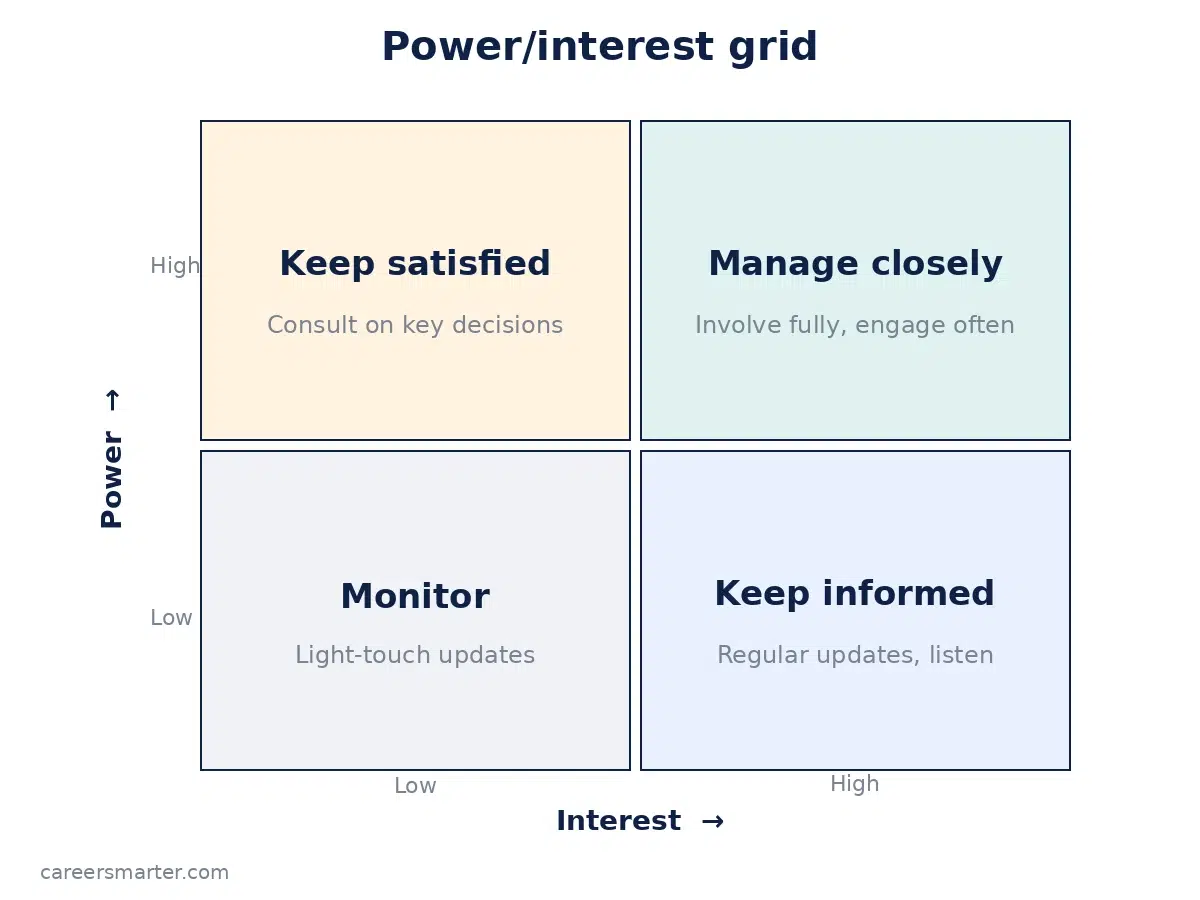
The quadrant that catches people out is keep satisfied. These are senior people who don’t care much about your project, until something affects them. A finance director who only hears about a budget overrun at the board meeting will move quickly from “keep satisfied” to “manage closely”, and not in a good way.
Stakeholder mapping vs stakeholder analysis
People use the terms interchangeably, but there’s a useful difference.
- Stakeholder analysis is the whole process: identifying, assessing, prioritising and planning.
- Stakeholder mapping is the visual part: plotting stakeholders on a grid or diagram so you can see the picture at a glance.
The power/interest grid is the most common map, but not the only one:
- Influence/impact grid: plots how much influence a stakeholder has against how much the project affects them. Useful for change projects, where impact on people matters as much as their interest.
- Salience model: scores stakeholders on power, legitimacy and urgency. Those with all three need attention first.
Our advice: start with the power/interest grid. Only reach for the others if it isn’t telling you enough.
Stakeholder analysis example
A UK insurance firm is replacing its customer relationship management (CRM) system. The project manager and business analyst run a stakeholder analysis in the first week.
| Stakeholder | Interest | Influence | Quadrant | Engagement approach |
|---|---|---|---|---|
| Sales director (sponsor) | High: owns the business case | High | Manage closely | Weekly one-to-one, chairs the steering group |
| Sales team (40 users) | High: daily users of the system | Low | Keep informed | Fortnightly updates, demo sessions, user testing |
| IT security lead | Low at first | High: can block go-live | Keep satisfied | Early review of data handling, sign-off at key points |
| Finance director | Low | High: controls the budget | Keep satisfied | Monthly cost summary, early warning of any overspend |
| Customer service team | High: will use customer records | Medium | Keep informed / manage closely | Include a team lead in requirements workshops |
| CRM supplier | High | Medium | Keep informed | Weekly delivery call |
| Customers | Low | Low | Monitor | Notify only if service changes |
The surprise here was the IT security lead. Nobody on the sales side had thought of them, but they could stop go-live in an afternoon. Getting them involved in week one saved weeks later.
Common stakeholder analysis mistakes
- Doing it once. People change roles, priorities shift and attitudes harden. Review the analysis at each stage, or at least monthly.
- Only listing senior people. The people doing the work, such as the call centre team who’ll use the new system, often decide whether a change sticks.
- Confusing support with interest. Someone can be very interested and still be against you. Track the two separately.
- Writing it in a way you can’t share. “Difficult, avoid” in a shared file will get forwarded. Describe concerns in neutral terms.
- Plotting the grid and stopping there. The grid is a starting point. The value is in the engagement plan that follows it.
How to handle a resistant stakeholder
Resistance is information. Usually it means someone stands to lose something: time, budget, status or control.
- Talk to them early and in private. Ask what worries them, then listen properly.
- Find the real concern. “The timeline’s unrealistic” might mean “my team is already stretched”.
- Change what you can. A different rollout date, extra training or a role in the design can turn a blocker into a supporter.
- Be honest about what you can’t change, and explain why.
- Escalate as a last resort, through the sponsor, and tell the stakeholder first.
A simple stakeholder communication plan
Your analysis should feed straight into a communication plan. For each stakeholder or group, note:
| Stakeholder | What they need to know | Format | How often | Owner |
|---|---|---|---|---|
| Sponsor | Progress, risks, decisions needed | One-to-one | Fortnightly | Project manager |
| Team leaders | Changes to their team’s work | Workshop | Monthly | Business analyst |
| End users | What’s changing and when | Email and drop-in sessions | At key milestones | Change lead |
| Supplier | Scope, dates, issues | Status call | Weekly | Project manager |
Stakeholder analysis template
A good template doesn’t need to be complicated. Include these columns:
- Stakeholder name and role
- Internal or external
- Interest in the project (what they want, what worries them)
- Interest level (high / low)
- Power or influence level (high / low)
- Current attitude (supportive / neutral / resistant)
- Quadrant
- Engagement approach and frequency
- Owner (who manages the relationship)
- Last reviewed
Download our free stakeholder analysis template (Excel) and the step-by-step guide (Word). It’s a spreadsheet with all of these columns, drop-down lists for interest, power and attitude, and a quadrant column that works out where each stakeholder sits on the power/interest grid for you. A short guide comes with it, explaining each step.
Stakeholder analysis in business analysis
For a business analyst, stakeholder analysis is the starting point for requirements work. If you don’t know who the stakeholders are, you don’t know whose needs you’re gathering, and you’ll find out about the missing ones at user acceptance testing.
BAs use it to plan who to interview, who to invite to workshops and whose sign-off they need. It also helps with conflicting requirements: when two senior stakeholders want different things, the analysis shows who has the final say.
If you’re heading into business analysis, our BCS-accredited courses cover stakeholder techniques in depth. Start with the BCS Foundation Certificate in Business Analysis, then build towards the BCS International Diploma in Business Analysis. Read what a business analyst actually does, or see the business analyst career path.
Stakeholder engagement in PRINCE2
In PRINCE2®, every project has three primary stakeholder interests: the business, users and suppliers. All three are represented on the project board, which is one way the method applies its principle of defining roles, responsibilities and relationships.
The detail of how a project will engage with stakeholders goes in the communication management approach. The project manager prepares it during the initiation stage as part of the project initiation documentation. It includes a stakeholder analysis, identifying who is affected by the project and how, and sets out how and when each stakeholder group will be communicated with. PRINCE2 stresses that it’s as much about listening as broadcasting. The approach is expected to evolve as the project becomes better defined, so keep your stakeholder analysis up to date alongside it. Your stakeholder analysis feeds straight into it, during the initiation phase of the project life cycle.
Learn the method on our PRINCE2 Foundation course, or browse all our PRINCE2 courses. Career Smarter is a PeopleCert Accredited Training Organisation for PRINCE2.
If your role is more about helping people through change, the Change Management Foundation course goes deeper on engagement and resistance. See also the change and improvement specialist career path and the project manager career path.
FAQs
What is stakeholder analysis? It’s the process of identifying everyone who can affect or is affected by a project, then assessing their interest and influence so you can decide how to engage each one.
What are the four steps of stakeholder analysis? Identify, analyse, prioritise and plan engagement. Most people use a power/interest grid for the prioritise step.
What is a power/interest grid? It’s a four-box grid that plots stakeholders by power and interest. The quadrants are manage closely, keep satisfied, keep informed and monitor.
What is the difference between stakeholder analysis and stakeholder mapping? Stakeholder analysis is the whole process. Stakeholder mapping is the visual part, where you plot stakeholders on a grid or diagram.
Who should do the stakeholder analysis on a project? Usually the project manager or business analyst leads it, but it works best as a team exercise. Different people know different stakeholders.
When should you do a stakeholder analysis? Early, ideally during initiation. Then review it at each stage, because stakeholders’ interest and influence change as the project moves on.
What should a stakeholder analysis template include? Name and role, interest, power, attitude, quadrant, engagement approach, owner and the date last reviewed.
What are the main types of stakeholders? The most useful splits are internal vs external and primary vs secondary. Lists of “types” vary, and none is official.