Project Life Cycle: The 5 Phases Explained
The project life cycle is the set of phases a project moves through, from initiation to closure. See the 5 phases, what happens in each, and how PRINCE2 and agile compare.


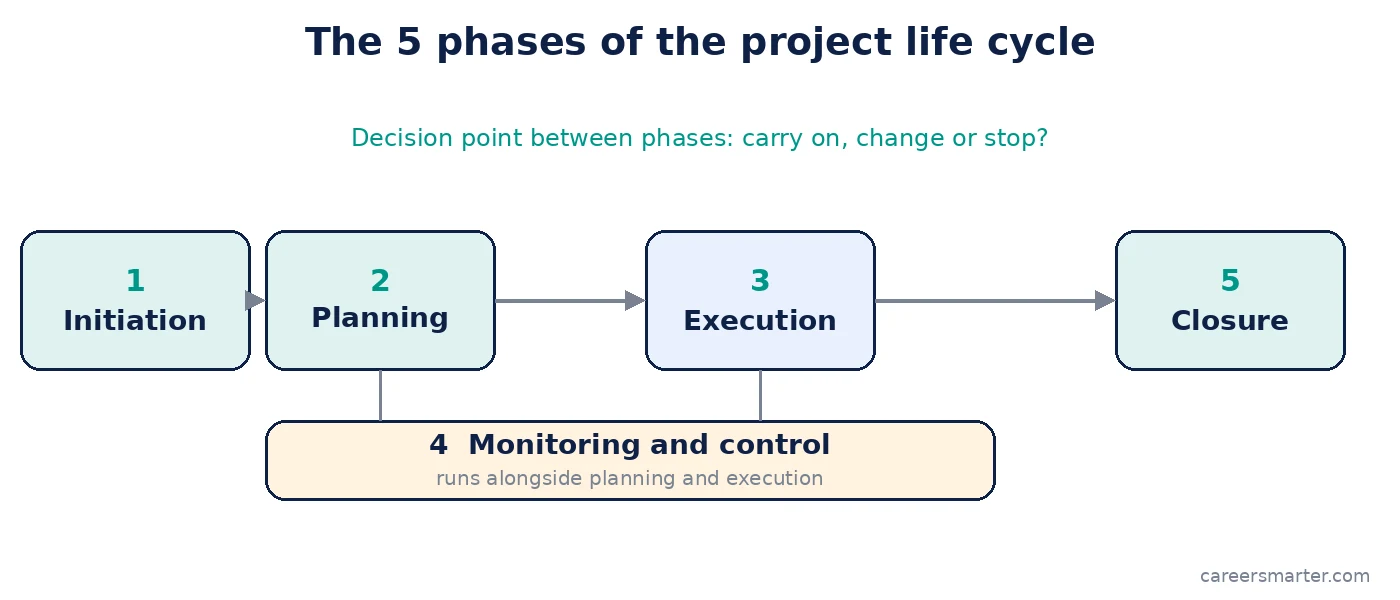
The project life cycle is the sequence of phases a project goes through from start to finish. Most models use five: initiation, planning, execution, monitoring and control, and closure. Each phase has its own outputs and a decision point before the next begins.
Here’s the part most guides skip: the phases aren’t a neat conveyor belt. Monitoring runs alongside execution, planning gets revisited, and a good project manager knows when to stop and ask whether the project should carry on at all. That decision point between phases is the most useful idea in this whole article. (Want templates to go with it? See our free project management resources.)
What is the project life cycle?
A project is temporary work with a defined start, end and outcome: launching a website, moving an office, rolling out a new system. Business-as-usual is the opposite. It’s the ongoing work that keeps an organisation running, like payroll or customer service.
The project life cycle gives that temporary work a shape. It splits the project into phases so you can plan in sensible chunks, check progress and decide, at each step, whether to keep going.
The 5 phases of the project life cycle
1. Initiation
Initiation is where you decide whether the project is worth doing.
You define the problem or opportunity, the rough scope and the expected benefits. You identify who has a stake in it (our guide to stakeholder analysis covers how). The typical output is a business case or project brief, and the sponsor decides whether to approve it.
Who’s involved: the sponsor, the proposed project manager and key stakeholders.
2. Planning
Planning turns an approved idea into a workable plan.
You break the work down, estimate time and cost, set dependencies, plan for risks and agree how you’ll communicate. This is where techniques like critical path analysis earn their keep, because they show which tasks can’t slip. A RAID log helps you keep track of risks, assumptions, issues and dependencies.
Typical outputs: a project plan, schedule, budget, risk register and communication plan.
3. Execution
Execution is where the team does the work and builds what the project promised.
It’s usually the longest and most expensive phase. The project manager’s job shifts from planning to coordinating people, removing blockers and keeping stakeholders informed.
Typical outputs: the deliverables themselves, plus status reports.
4. Monitoring and control
Monitoring and control means comparing what’s happening with the plan and acting when they drift apart.
It runs alongside execution rather than after it. You track progress, cost, quality and risk, manage change requests and escalate when something goes beyond agreed limits.
Typical outputs: progress reports, updated plans, change logs and issue logs.
5. Closure
Closure is the formal end of the project.
You hand over the deliverables, confirm the sponsor accepts them, release the team, close contracts and capture lessons learned. Skipping closure is common, and it’s a mistake. Without it, projects drift on, and nobody learns anything for next time.
Typical outputs: a handover, an end-of-project report and a lessons-learned record.
Key documents in each phase
You don’t need a mountain of paperwork, but each phase usually produces a few core documents:
| Phase | Typical documents |
|---|---|
| Initiation | Business case, project brief or charter, initial stakeholder list |
| Planning | Project plan, schedule, budget, risk register, communication plan |
| Execution | Work packages, change requests, team updates |
| Monitoring and control | Progress reports, issue log, updated risk register |
| Closure | Handover document, lessons learned report, end-of-project report |
Scale these to the project. A two-week internal project might fit them all on a few pages. A large IT rollout will need each of them in full.
Common mistakes in each phase
Most project problems start in a phase that looked like it was going fine.
- Initiation: skipping the business case. If nobody can say why the project is worth doing, nobody can say when it should stop.
- Planning: planning the work but not the risks. A schedule with no slack for anything going wrong is a wish, not a plan.
- Execution: letting scope creep in through small favours. Every “can you just add…” request should go through change control.
- Monitoring and control: reporting green until it’s suddenly red. Honest reporting early gives the sponsor time to act.
- Closure: not closing at all. Projects that drift on with no formal handover leave the team stuck supporting them for months, and the lessons never get written down.
How to choose the right life cycle for your project
Ask three questions:
- How clear are the requirements? If you know exactly what’s needed (a building, an office move), a predictive life cycle works well. If the requirements will change as people see the product, go iterative or agile.
- How costly is change later on? Where late changes are expensive, plan more up front.
- How soon do users need something? If early value matters, deliver in increments.
Many real projects mix the two: a predictive plan for the overall stages, with agile delivery inside them.
Project life cycle diagram
Worked example: an office move
Picture a 60-person team moving from one London office to another.
- Initiation. The lease is ending. The operations director writes a brief: move by a fixed date, with no more than one day of downtime. The board approves it.
- Planning. The project manager lists the tasks: find and agree the new site, plan the IT and network set-up, book removals, plan desk layouts and tell staff. They spot that the network installation has the longest lead time, so it goes on the critical path.
- Execution. The fit-out happens, IT installs the network, and removals are booked for a Friday night.
- Monitoring and control. The furniture supplier warns of a two-week delay. The PM checks the plan: furniture isn’t on the critical path, so they agree temporary desks rather than moving the date.
- Closure. Staff start in the new office on Monday. The PM gets sign-off from the director, closes supplier contracts and records lessons learned, such as booking the network installation even earlier next time.
Project life cycle vs project management life cycle vs product life cycle
These terms get mixed up all the time.
| Term | What it describes | Example |
|---|---|---|
| Project life cycle | The phases of the project’s work, from start to finish | Design, build, test, launch a new app |
| Project management life cycle | The management activities wrapped around that work | Initiate, plan, execute, monitor and control, close |
| Product life cycle | The life of the product after (and beyond) the project | Introduction, growth, maturity, decline |
In practice, many people use the first two interchangeably, and the five phases in this article are the management view. The product life cycle is different: a project might create a product, but the product lives on long after the project closes.
Predictive, iterative and agile life cycles
Not every project should run its phases in a straight line.
- Predictive (waterfall). You plan everything up front, then deliver in sequence. It suits work where the requirements are clear and change is costly, like construction or an office move.
- Iterative. You build in repeated cycles, improving the product each time. It suits work where you learn as you go.
- Agile. You deliver small, usable pieces in short time-boxes and adapt the plan based on feedback. It suits software and other work where requirements change.
Our view? Most real projects are hybrids. You might fix the budget and deadline up front but deliver the features in agile increments. If that’s the kind of work you do, look at the AgilePM Foundation course or the PRINCE2 Agile Foundation course, which combines PRINCE2’s governance with agile delivery.
How PRINCE2 structures a project
PRINCE2® doesn’t use the generic five phases. Instead, it divides a project into management stages. “Manage by stages” is one of its seven principles, and at the end of each stage the project board decides whether the project should continue. That’s the “decision point” idea built into the method, and it links to another principle: ensure continued business justification.
Every PRINCE2 project has at least two management stages. The first is the initiation stage, where the project is planned and the project initiation documentation is put together. After that come one or more delivery stages. How many depends on the size and risk of the project.
The method also sets out seven processes that run from start to finish: starting up a project, directing a project, initiating a project, controlling a stage, managing product delivery, managing a stage boundary and closing a project. Alongside these sit seven practices (business case, organizing, plans, quality, risk, issues and progress), which are applied throughout. Our guide to PRINCE2 project stages explains the stages in more detail.
If you want to learn the method properly, the PRINCE2 Foundation course is the place to start. Career Smarter is a PeopleCert Accredited Training Organisation for PRINCE2. Browse all our PRINCE2 courses.
Project vs programme
A project delivers a defined output, like a new system. A programme is a group of related projects managed together to deliver a bigger change and its benefits, like a company-wide digital transformation. Programmes usually last longer and focus on outcomes rather than outputs. Read more in our guide to what MSP is.
Where the project life cycle fits in your career
If you’re aiming for a PM role, knowing the life cycle is table stakes. Interviewers will ask how you’d run each phase. The project manager career path and the agile project manager career path show the courses in order, and our guide to becoming a project manager in the UK with no experience covers the first step.
FAQs
What is a project life cycle? It’s the sequence of phases a project goes through from start to finish. Most models use five phases, each with its own outputs and a decision point before the next.
What are the 5 phases of the project life cycle? Initiation, planning, execution, monitoring and control, and closure. Monitoring and control runs alongside execution rather than after it.
What is the most important phase of a project? We’d say planning, because mistakes made there cost the most to fix later. But initiation is a close second: a well-planned project that shouldn’t exist is still a waste.
What is the difference between the project life cycle and the project management life cycle? The project life cycle describes the work itself, such as design, build and test. The project management life cycle describes the management activities around it. Many people use the terms interchangeably.
What is an agile project life cycle? It delivers the project in short, repeated cycles, each producing something usable. The team adapts the plan based on feedback rather than fixing everything up front.
How does PRINCE2 divide a project into stages? PRINCE2 splits a project into management stages. At the end of each one, the project board reviews progress and decides whether to continue.
What is the difference between a project and a programme? A project delivers a defined output. A programme coordinates several related projects to deliver a bigger change and its benefits.
Is the project life cycle the same in every methodology? No. Each method names and structures the phases differently, because each one is built for different kinds of work and different levels of control.