Critical Path Analysis: A Step-by-Step Guide with Example
Critical path analysis finds the longest chain of dependent tasks, which sets the shortest time a project can take. Learn the 6 steps with a worked example and float.


Critical path analysis (CPA) is a planning technique that finds the longest sequence of dependent tasks in a project. That sequence, the critical path, sets the shortest possible project duration. Any delay to a task on it delays the whole project; tasks off it have float.
The counter-intuitive bit: the critical path is the longest route through your plan, yet it tells you the shortest time the project can take. Once that clicks, the rest is arithmetic. We’ll walk through it with a real example you can copy. (For templates and checklists, see our free project management resources.)
What is critical path analysis?
CPA maps every task in a project, the order they must happen in and how long each takes. From that, it shows which tasks control the end date and which have room to slip.
You’ll also see it called the critical path method (CPM). It’s the same idea under a different name. CPM is the more common term in the US and in software tools; CPA is common in UK textbooks and A-level business courses.
It’s used wherever timing matters: construction, events, IT rollouts, product launches and office moves. It sits in the planning phase of the project life cycle.
Key terms
- Activity: a task that takes time, such as “write course content”.
- Dependency: a task that can’t start until another finishes.
- Duration: how long an activity takes.
- Earliest start (ES) / earliest finish (EF): the soonest an activity can start and finish.
- Latest start (LS) / latest finish (LF): the latest it can start and finish without delaying the project.
- Float (slack): how long an activity can slip without delaying the project.
- Critical path: the chain of activities with zero float.
How to do critical path analysis in 6 steps
1. List the activities
Write down every task needed to finish the project. Keep them at a level you can estimate: “build booking page”, not “do the website”.
2. Set the dependencies
For each activity, ask: what has to finish before this can start? Be strict. A soft preference isn’t a dependency, and adding false ones makes the critical path look longer than it is.
3. Estimate durations
Give each activity a duration in the same unit, usually days. Ask the person doing the work, not just the person planning it.
4. Draw the network
Draw each activity as a box and connect them with arrows showing the dependencies. The diagram makes gaps and loops obvious.
5. Do the forward and backward pass
The forward pass works left to right. Each activity’s earliest start is the latest earliest-finish of everything it depends on. Earliest finish = earliest start + duration.
The backward pass works right to left from the project end date. Each activity’s latest finish is the smallest latest-start of everything that depends on it. Latest start = latest finish − duration.
6. Find the critical path and the float
Float = latest start − earliest start. Activities with zero float form the critical path.
Critical path analysis example
Let’s say a team is launching a new online training course. Here are the activities.
| Activity | Description | Depends on | Duration (days) |
|---|---|---|---|
| A | Agree course scope | – | 3 |
| B | Write course content | A | 10 |
| C | Build booking page | A | 4 |
| D | Design slides and workbooks | B | 5 |
| E | Recruit a trainer | A | 6 |
| F | Test booking and payments | C | 2 |
| G | Run a pilot session | D, E | 2 |
| H | Marketing launch | F, G | 3 |
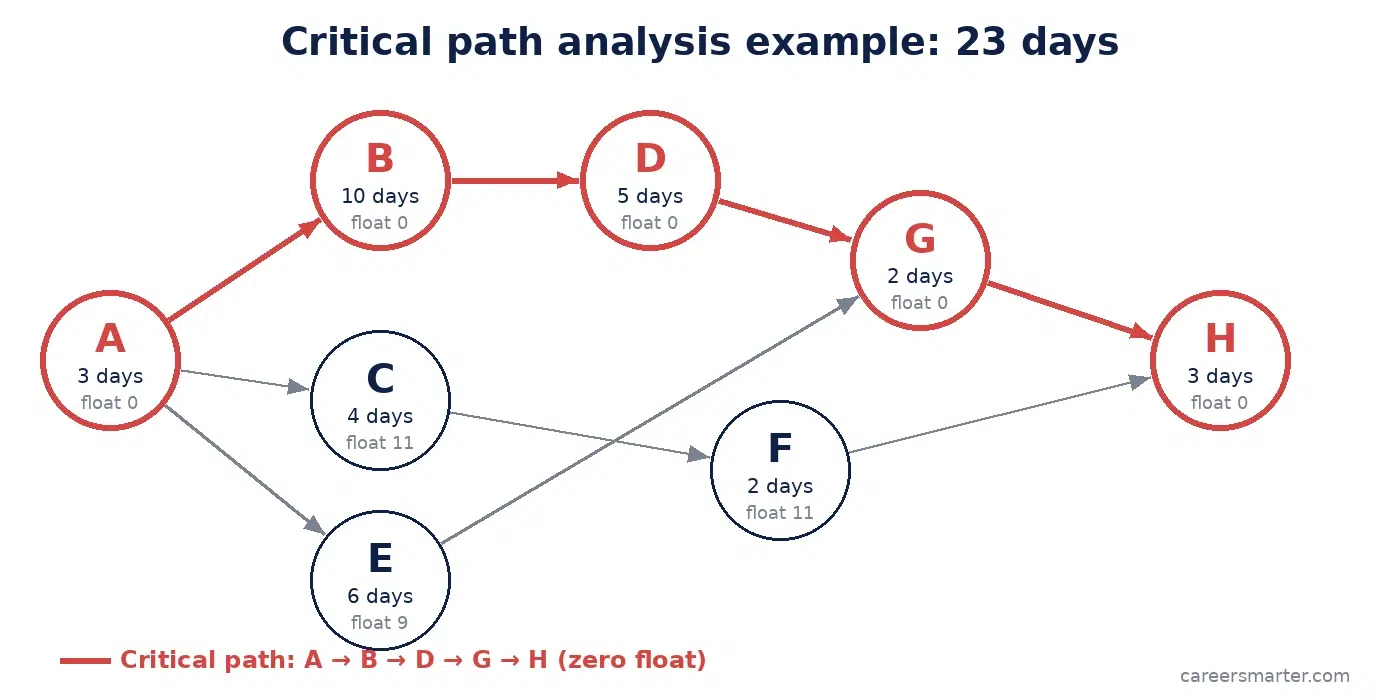
Forward pass (day 0 is the start):
- A: ES 0, EF 3
- B: ES 3, EF 13
- C: ES 3, EF 7
- E: ES 3, EF 9
- D: ES 13, EF 18
- F: ES 7, EF 9
- G: waits for D (18) and E (9), so ES 18, EF 20
- H: waits for F (9) and G (20), so ES 20, EF 23
The project takes 23 days.
Backward pass (from day 23):
- H: LF 23, LS 20
- G: LF 20, LS 18
- F: LF 20, LS 18
- D: LF 18, LS 13
- E: LF 18, LS 12
- C: LF 18 (F’s latest start), LS 14
- B: LF 13, LS 3
- A: LF is the smallest of B (3), C (14) and E (12), so LF 3, LS 0
Results:
| Activity | ES | EF | LS | LF | Float |
|---|---|---|---|---|---|
| A | 0 | 3 | 0 | 3 | 0 |
| B | 3 | 13 | 3 | 13 | 0 |
| C | 3 | 7 | 14 | 18 | 11 |
| D | 13 | 18 | 13 | 18 | 0 |
| E | 3 | 9 | 12 | 18 | 9 |
| F | 7 | 9 | 18 | 20 | 11 |
| G | 18 | 20 | 18 | 20 | 0 |
| H | 20 | 23 | 20 | 23 | 0 |
The critical path is A → B → D → G → H, and 3 + 10 + 5 + 2 + 3 = 23 days.
What does that tell the team? Writing the content is the real bottleneck. If it runs two days late, launch slips two days. The booking page, by contrast, could slip by more than a week and nobody would notice the launch date move.
How to calculate float
Float = latest start − earliest start (or latest finish − earliest finish; you get the same answer).
In the example, recruiting a trainer (E) has an earliest start of day 3 and a latest start of day 12, so it has 12 − 3 = 9 days of float.
Advantages and disadvantages of critical path analysis
Advantages
- It shows which tasks control the end date, so you know where to focus.
- It tells you where you have slack to move people or absorb delays.
- It forces the team to agree dependencies early.
- It gives you a defensible answer to “when will it be done?”
Disadvantages
- It’s only as good as your duration estimates.
- It assumes durations are fixed, when real tasks vary.
- It doesn’t account for resources by itself: two critical tasks might need the same person.
- Large networks get hard to maintain by hand, so you’ll need software.
- It suits fixed-scope work better than fast-changing projects.
Critical path vs Gantt chart vs PERT
| Technique | What it shows | Best for |
|---|---|---|
| Critical path analysis | Dependencies, the longest chain and float | Finding what controls the end date |
| Gantt chart | Tasks as bars on a timeline | Communicating the schedule to people |
| PERT | Durations estimated as optimistic, most likely and pessimistic | Projects where durations are uncertain |
They work well together. Most teams run CPA to find the critical path, then show it on a Gantt chart so everyone can see it.
Critical path analysis in PRINCE2 and agile projects
In PRINCE2®, CPA is a planning technique you can use when building stage and project plans. It helps the project manager show the project board what drives the schedule and where tolerances are tight. Pair it with a RAID log to track the risks and dependencies behind each estimate.
In agile projects, CPA plays a smaller role. Teams plan in short time-boxes and re-prioritise often, so a detailed network of every task wouldn’t survive the first sprint. It still helps at release level, though. If three features must ship before a fixed launch date, someone needs to know which one controls it.
Want to plan projects like this for a living? The PRINCE2 Foundation course teaches structured planning, and the AgilePM Foundation course covers agile delivery. Browse all our PRINCE2 courses, or see the project manager career path.
Free template
Want to skip the arithmetic? Download our free critical path analysis template. It’s a spreadsheet with columns for each activity, its dependencies and its duration. The earliest and latest start and finish dates, the float and the critical activities all calculate automatically, and it comes pre-filled with the training course example above so you can see how it works before you add your own plan.
FAQs
What is critical path analysis? It’s a planning technique that finds the longest chain of dependent tasks in a project. That chain sets the shortest time the project can take.
How do you calculate the critical path? List the activities, dependencies and durations, then do a forward and backward pass. The activities with zero float form the critical path.
What is float in critical path analysis? Float is how long an activity can slip without delaying the project. It’s the latest start minus the earliest start.
What is the difference between critical path analysis and the critical path method? There isn’t one, really. They’re two names for the same technique; CPM is more common in the US and in software tools.
Can a project have more than one critical path? Yes. If two chains of activities have the same longest duration, both are critical, and a delay on either delays the project.
What happens if a task on the critical path is delayed? The whole project is delayed by the same amount, unless you shorten a later critical task to win the time back.
What are the disadvantages of critical path analysis? It depends on accurate estimates, treats durations as fixed and doesn’t handle resource clashes on its own. Large networks also need software.
Is critical path analysis used in agile? Less so day to day, because agile teams re-plan often. It’s still useful at release level when several pieces of work must land before a fixed date.